The Indian education system includes several academic boards, but the Central Board of Secondary Education is one of the most trusted options for families. Many parents and students often ask, “what is CBSE curriculum” and why it is preferred by millions of learners across India.
The CBSE curriculum is designed to promote conceptual learning, skill development, and academic consistency. It supports students from primary school to senior secondary education with a student centered approach. Thousands of affiliated schools follow the CBSE syllabus because it prepares students for higher education, entrance exam preparation, and modern careers.
What is CBSE Curriculum ?
The Central Board of Secondary Education (CBSE) is one of the most widely recognized education boards in India, known for its well-structured and student-centered approach. Understanding what is CBSE curriculum means exploring how this system shapes learning, encourages skill development, and prepares students for both higher education and real-world challenges.
The Core Philosophy of the CBSE Curriculum
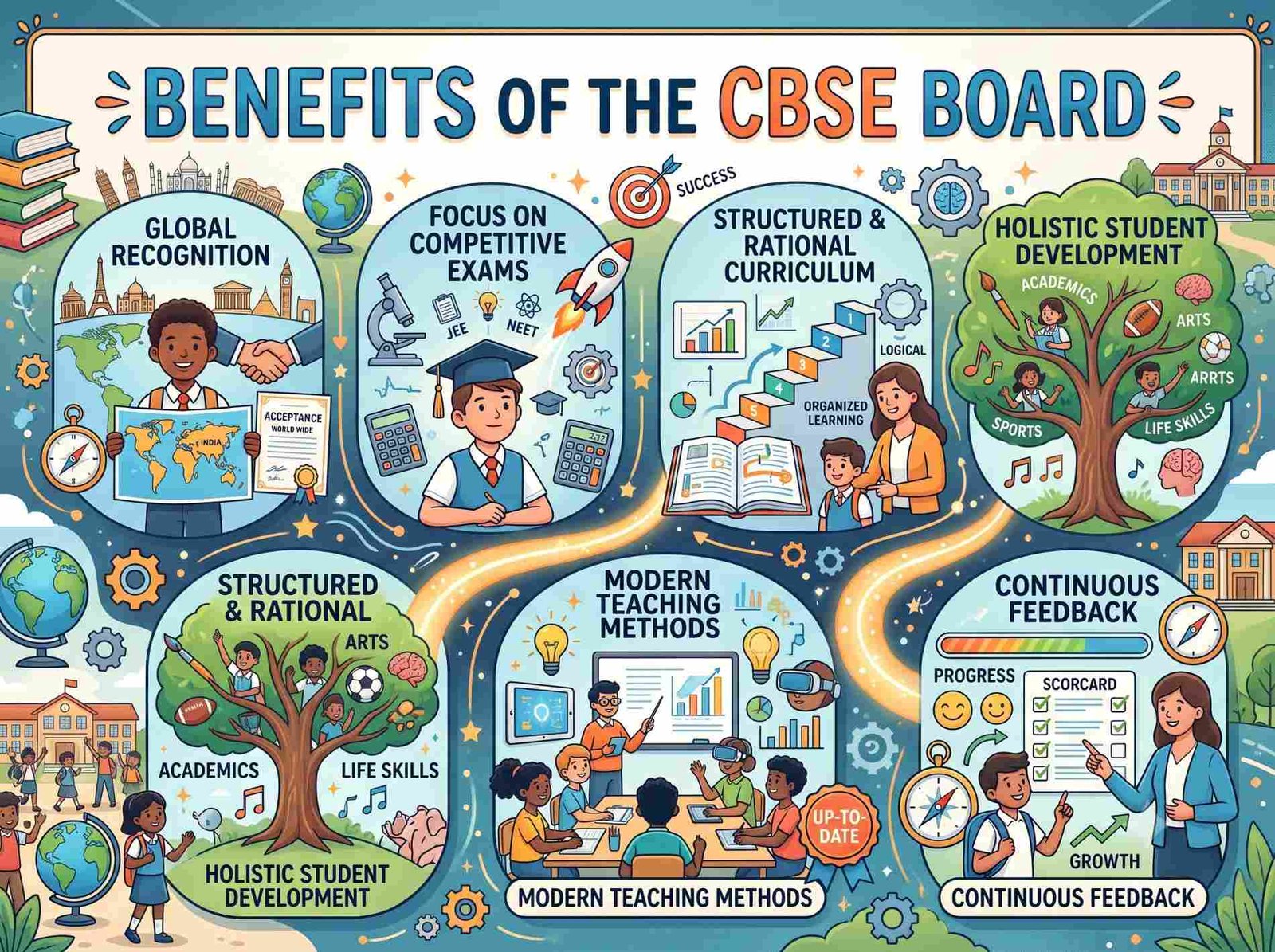
At its heart, the CBSE curriculum emphasizes conceptual understanding, critical thinking, and life skills. It is built to nurture learners through a balanced approach—combining academic rigor with creative and practical learning experiences.
CBSE aims to provide a holistic education system that fosters intellectual, emotional, and ethical growth.
The Central Board of Secondary Education ensures that all CBSE-affiliated schools follow a uniform academic standard across India and abroad. This consistency helps maintain quality education accessible to students from diverse backgrounds.
Structure of the CBSE Curriculum
The CBSE syllabus is divided across three primary stages:
Primary Level (Classes I–V):
Focuses on basic literacy, numeracy, environmental science, and foundational communication skills.
Secondary Level (Classes VI–X):
Introduces a range of subjects such as mathematics, science (physics, chemistry, biology), and social science to build subject-oriented knowledge.
Senior Secondary Level (Classes XI–XII):
Allows specialization through streams like Science, Commerce, and Humanities. Subjects may include Business Studies, Economics, Physics, Chemistry, Mathematics, and English, preparing students for higher education and professional courses.
The secondary education CBSE phase also stresses project-based learning and experiments, empowering students to apply theoretical knowledge practically.
Features That Make CBSE Stand Out
- Student-Centered Learning: Lessons are designed to engage students actively, making the learning experience more interactive.
- Skill Development: Beyond academics, CBSE encourages problem-solving, communication, and collaboration through co-curricular activities.
- Standardized Assessment: The board of secondary education conducts annual CBSE exams for Class X and XII, ensuring fairness and transparency.
- Adaptability: The syllabus evolves to stay relevant with technological and pedagogical advancements, guided by the National Education Policy (NEP).
- Preparation for Competitive Exams: The CBSE curriculum aligns closely with national-level entrance exams like JEE and NEET, giving CBSE students an advantage in competitive contexts.
Subjects and Syllabus
The CBSE offers a wide range of subjects, including core sciences like Physics and Chemistry, Mathematics, Humanities, Business Studies, and emerging fields that align with modern educational needs. The curriculum is designed to be dynamic, continuously evolving to incorporate new educational trends and disciplines.
Core Subjects:
These include Mathematics, Science, and Languages, forming the backbone of the curriculum.
Elective Subjects:
Students can also choose from a variety of elective subjects, allowing them to tailor their education to their interests and career aspirations.
Learning Beyond Books
The modern CBSE schools integrate 21st-century skills like digital literacy, entrepreneurship, and environmental awareness. Through programs on life skills and value-based education, students learn empathy, teamwork, and ethics alongside academics.
CBSE’s pedagogical approach supports experiential learning, group projects, and inquiry-based assessments. This encourages curiosity, creativity, and critical problem-solving abilities that go far beyond rote learning.
Examination Framework
CBSE examinations are known for their standardization and fairness, providing a credible system for evaluating student performance. The board exams conducted by CBSE are crucial as they serve as significant milestones in a student's educational trajectory.
- Board Exams: CBSE board exams are held for students in the 10th and 12th grades, assessing their knowledge and skills comprehensively.
- Competitive Exams Preparation: The rigorous CBSE syllabus also aids students in preparing for various competitive entrance exams for higher education in engineering, medicine, and other fields.
Importance for Higher Education and Career
The CBSE curriculum is globally recognized, allowing seamless higher education opportunities in India and abroad. Universities worldwide acknowledge the uniform grading and academic rigor of CBSE exams, giving graduates a competitive advantage.
Since CBSE emphasizes analytical thinking and application-based learning, students are well-prepared for competitive exams and diverse professional domains. Many educational platforms like Skoodos.com and CareerGuide.com highlight how CBSE alumni excel in leadership, entrepreneurship, and innovation.
Technology and Modernization in CBSE
Digital integration is central to CBSE’s modern framework. Innovative platforms such as InfigonFutures.com and Glarity.app show how technology enhances teaching through smart classrooms, AI-learning modules, and digital assessment systems.
CBSE has also partnered with various education tech organizations to provide online courses and certifications, enabling continuous learning beyond traditional classrooms.
Why Parents and Students Prefer CBSE
Parents often choose CBSE schools for their national recognition, balanced pedagogy, and well-designed curriculum. CBSE ensures:
- Smooth transferability between schools across states or countries.
- High academic standards suitable for both Indian and international education pathways.
- A unified system supporting emotional, moral, and intellectual development.
Future Scope of CBSE Education
The central board of secondary education continues to improve the curriculum with modern reforms. Schools are now introducing coding, artificial intelligence, vocational learning, robotics, and multidisciplinary education.
The goal is to prepare students for future careers and global opportunities while improving creativity, adaptability, and problem-solving abilities.
Quick Snapshot: What’s New for 2026?
Two Board Exams:
Two chances to sit for Class 10 and 12 exams; higher score wins.
Competency-Based Learning:
Tests will focus on how you apply knowledge, not just what you remember.
AI Integration:
Artificial Intelligence and digital literacy are now core parts of the journey.
Vocational Focus:
Mandatory skill-based subjects to prepare students for the modern workforce.
Flexible Maths & Science:
Choice between standard and advanced levels to suit your individual strengths.
Conclusion
Understanding what is CBSE curriculum opens a gateway to appreciating India’s most dynamic and globally aligned education system. With its focus on student-centered learning, competency-based evaluation, and skill development, CBSE not only builds academic excellence but also cultivates lifelong learners ready for a rapidly changing world.
From board exams to life skills, the curriculum continuously evolves to prepare future generations for success in higher education and beyond. Students from CBSE-affiliated schools are not just exam-ready—they’re globally competent, innovative thinkers positioned to thrive in any career path.